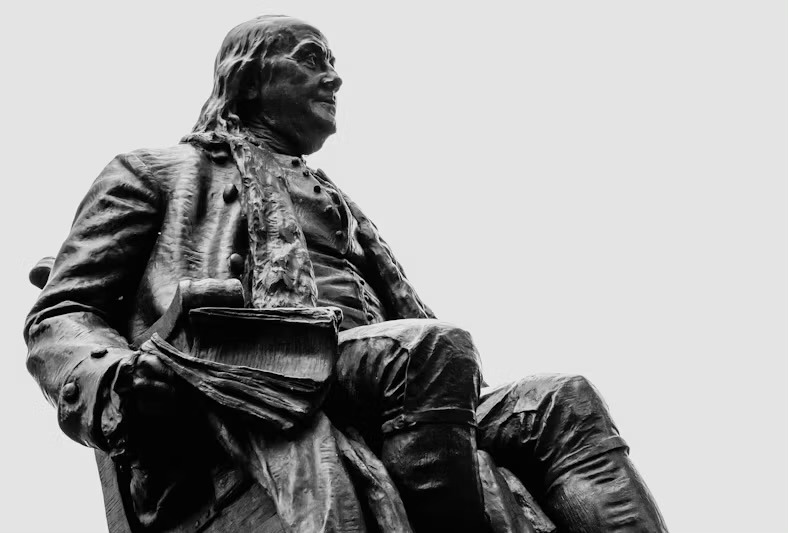
Important estate planning wisdom can be gleaned from Benjamin Franklin.
Benjamin Franklin believed in both personal responsibility and long-term planning.
Throughout his life, he made sacrifices and strategic decisions to promote his future well-being and to provide quality work for the good of his community.
When he died, Benjamin Franklin enshrined these values in his last will and testament.
At his death, Franklin bequeathed £1,000 to Philadelphia and Boston, with conditions that the money be kept and invested rather than spent immediately.
He directed the funds be used for the first 100 years to provide low-interest loans to beginning tradesmen.
These included bricklayers, carpenters, and blacksmiths.
All loan repayments and the interest earned were directed to be reinvested.
After the first century, the cities continued to limit their use of and access to the funds.
With his foresight, Benjamin Franklin grew his original bequest from roughly $4,000 to more than $6.5 million by 1990.
Long-term planning strategies can still benefit individuals and families.
While most people consider selecting recipients the most important estate planning matter, Benjamin Franklin prioritized the purpose of his financial gifts.
Franklin desired to support hardworking men by providing opportunity through capital and education.
By including values in modern estate planning, you can support a child or grandchild by providing funds for education and fiscal responsibility.
Because trusts allow for more structure, they can be indispensable tools for establishing terms for achieving your estate planning goals.
When a last will and testament or other beneficiary distribution instrument transfers property directly to an heir, the recipient has complete control of the asset.
If you have no preference for how the funds are used, this arrangement may be sufficient.
If you desire for an inheritance to be used for a specific purpose, your estate plan may demand more than merely naming beneficiaries.
The estate of Benjamin Franklin provides a concrete example of the difference between merely transferring money and designating gifts to achieve a specific goal.
When choosing the best structure for your estate plan, consider what you want an inheritance to accomplish.
Because Franklin restricted Boston and Philadelphia from spending all of his contributions immediately, the gift generated returns on the original capital, extending benefits to future generations.
Strategic long-term planning does not require detailed provisions for two centuries.
Instead, a trust can gradually distribute funds to beneficiaries after they reach certain milestones or designated ages.
Delaying inheritances can give beneficiaries time to mature their financial judgment before receiving a large sum.
Although Benjamin Franklin included restrictions in his estate plan, he did not micromanage every future action.
He provided a framework for how money could be used and accessed while giving the cities authority to administer the funds.
Modern estate planning also requires trusts to balance structure and flexibility.
If the terms are too rigid, the guidelines may become impractical.
When trust terms give the trustee unlimited discretion, the estate planning instrument may fail in its intended purpose.
The best trusts let a trustee use discretion within clearly articulated boundaries to adapt to evolving circumstances while preserving the original intent.
The value of a good estate plan administrator is also underscored by the estate plan of Benjamin Franklin.
Although Philadelphia and Boston received the same gifts with identical instructions, they produced different results because of how the cities managed the funds.
When administration included loan defaults, incomplete records, inefficiencies, and other problems, it impacted the growth of the gift.
Careful consideration should be given to who one selects as a trustee.
Whether an institution or individual, the trustee must keep appropriate records, understand the trust terms, exercise wise judgment, and remain accountable to the trust's purpose and its beneficiaries.
Despite imperfect administration and changing situations, the estate plan of Benjamin Franklin proved successful.
Modern estate planning should also account for instances where a trustee may be unwilling or unable to serve.
A trust should include a process for replacing a trustee, establish accountability measures, and guide successor trustees in understanding the trustmaker's intent in creating the trust.
Creating contingencies in estate planning allows a trust to withstand unexpected situations.
The significance of Benjamin Franklin's bequests to Philadelphia and Boston extends beyond the amount he provided to support vocational education, scholarships, civic improvements, and community projects.
The key success of his estate plan was its ability to connect the funds with his values.
Although modern estate plans may not reflect the sheer ambition of this one crafted by Benjamin Franklin, the use of charitable gifts, trusts, and other structures can align inheritances with personal priorities.
This historic gift illustrates how a strategic estate planning design can protect wealth and values long beyond the life of a single person.
Benjamin Franklin prioritized his personal values in his estate plan rather than focusing solely on his intended recipients.
By establishing distributions over time, you can support financial management as beneficiaries mature.
Because poor administration can undermine a carefully designed plan, choose trustees carefully.
An experienced estate planning attorney can help you create a trust with flexibility, procedures for changing fiduciaries, clear standards, and accountability to promote your values and legacy.
This post is for informational purposes only and does not provide legal advice. You should consult an attorney for advice on any specific issue or problem. Nothing herein creates an attorney-client relationship between Harvest Law KC and the reader.
Reference: Elder Law Answers (Feb. 24, 2026) “Benjamin Franklin's Estate Planning Lessons”

REMEMBER: “The choice of a lawyer is an important decision and should not be based solely upon advertisements.”
This statement is required by rule of the Supreme Court of Missouri.